
How Ralla connects participants using AI-powered embeddings
The Challenge
One of the biggest challenges experience designers and event organizers face is how to get participants to engage each other. There’s an art to icebreakers and setting the cadence of social activities, but success ultimately relies on participant motivation.
Exploring how we can get participants to share their interests led quickly to two realizations:
- It’s useful to assume a preparatory stage in an activity before an event goes “Live”. A moment to check in and decide what to share and where to focus. In our case, it’s a perfect window for participants to share their personal interests.
- Connecting people becomes ever more relevant at larger events, when existing connections are weaker. The technological solution you use needs to deliver specific recommendations at scale.
Why Embeddings?
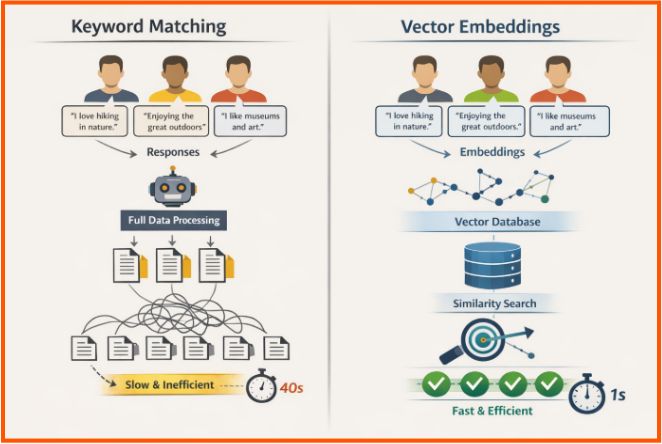
Embeddings rely on the same “semantic engine” that drives LLMs – they’re able to interpret meaning – but they have a different application. First, their job is to create a map that places all the content you provide in context. Second, embeddings create that map more quickly than any less sophisticated alternatives.
The mapping turns out to be important for two reasons:
- If you’re looking for shared interests between participants, a content mapping allows you to target your search for matches – you don’t have to look at all the content.
- Despite the fact that someone at an event probably shared your birthday, it’s surprisingly rare for people to share precisely the same interest. A spatial mapping makes it possible to look at adjacent interests and find relevant connections that will still be meaningful to participants.
Speed and Scale
It’s intuitive that getting answers quickly is important for a live event. More importantly, because embeddings are a map onto which content is placed, their efficiency makes certain important operations much less costly.
For example, our experiments have included mapping the content of something on the scale of a museum or amusement park. With that completed, locating an individual person’s interest on the map is only an incremental additional step. But the outcome is that we can make recommendations to the participant about the aspects of a large or complex experience that they would enjoy more.