
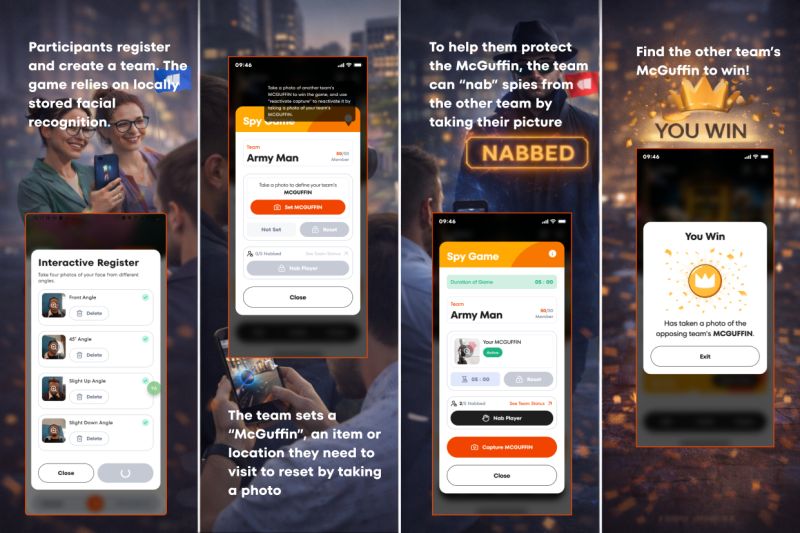
SpyGame allows two teams to compete to discover their opponents’ hidden secret object. Each team is required to reset their own “McGuffin” at regular intervals and must rely on misdirection and guile to do so without revealing its location.
AI-Powered Image Recognition
SpyGame relies on two AI-powered features. The first, which we’ve shown before in our Copy Cat walkthrough, is image recognition. In the case of SpyGame, this lets a team define a secret item – a “McGuffin” – that they will protect during the game. Image recognition allows the object to be known by the game while being a secret kept from the opposing team.
Dynamic Roles with On-Device Facial Recognition
The second feature is the ability to give participants real-world roles and capabilities for the game.
Most in-person games are interesting because the participants can play different roles. Normally, we’re limited to simple roles (you’re either “It” or being chased in tag), or to games where the roles are hidden and unchanging and participants are limited to relying on their ability to misdirect or surprise each other (think “Werewolf” and similar games). We wanted to create a system in which participants could have richer, more engaging roles.
To do that, we needed to address two priorities: first, the ability for participants to interact quickly, and second, the ability for participants to maintain control over their personally identifiable information.
Privacy by Design
Our solution is to use facial recognition running on the device that is separate from phone facial recognition services. In this model, opted-in participants create a face ID using the app. It stores simple vectors for each participant. This creates a system in which all participants are anonymous but identifiable to the game.
Being able to identify each participant’s face ID means the game can give them different roles that change as they’re tagged by other players or when the game state changes. And it means we can delete the numerical embedding vectors used in the game when the activity is over.